How to Choose a Commercial Kitchen Equipment Manufacturer in Bangalore
Who this is forThis guide is for restaurant, hotel and canteen owners in Bangalore choosing between a genuine kitchen equipment manufacturer and a reseller.
To choose a commercial kitchen equipment manufacturer in Bangalore, look for a company that actually fabricates in-house, confirms material grade in writing, and runs its own after-sales service team. A genuine manufacturer controls quality from raw steel to installed unit. A reseller simply buys finished equipment and marks it up, with no control over how it was built or what grade it uses. The difference shows within a year of daily service. These are the criteria any serious buyer should demand, and they are the same criteria Steelkraft is built to meet. This guide sets out how to evaluate a supplier honestly.
Key facts
- A genuine manufacturer fabricates equipment in-house, while a reseller buys finished units and marks them up without controlling quality.
- The most important checks are in-house fabrication capability, written material grade confirmation, and a real after-sales service team.
- ISO 9001:2015 certification indicates a documented, consistent quality management process rather than one-off good work.
- A site visit and genuine project references are the clearest evidence that a supplier can deliver and support a full kitchen.
Manufacturer versus reseller
The first thing to establish is whether you are talking to a manufacturer or a reseller. A manufacturer owns the fabrication process, cuts and welds the steel, and can build to your exact floor plan. A reseller sources finished units from various makers and sells them on. A reseller can be convenient for standard items, but for a full kitchen you lose control over grade, build quality and the ability to customise. Ask directly whether they fabricate in-house and ask to see the workshop. The best kitchen equipment manufacturers in Bangalore and commercial kitchen equipment manufacturers in Bangalore invite that scrutiny rather than deflect it.
In-house fabrication capability
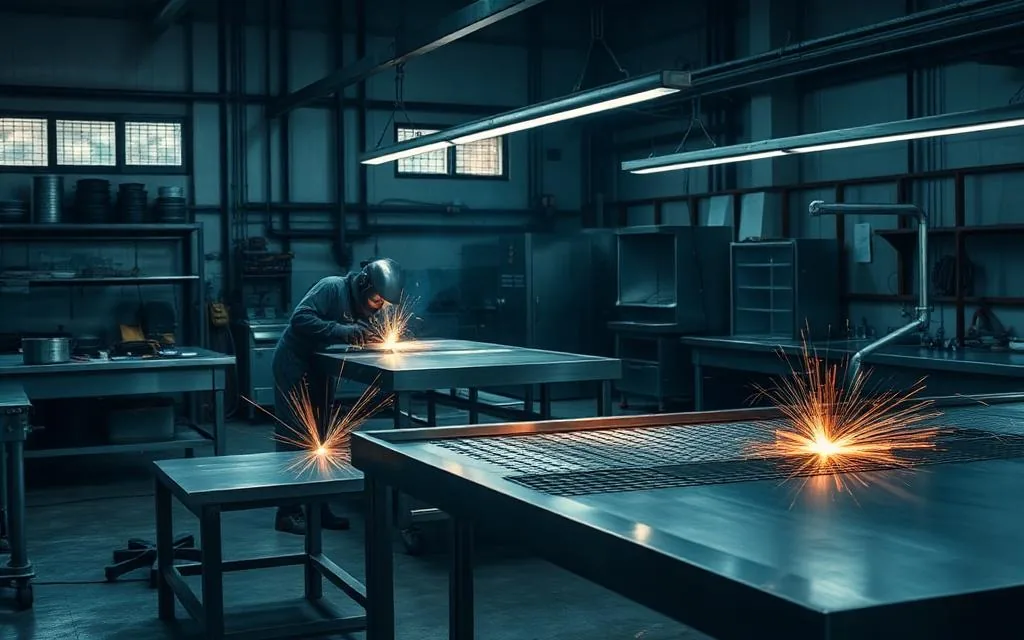
In-house fabrication is the single strongest indicator of a real manufacturer. It means the company controls cutting, forming, welding and finishing, and can match equipment to awkward corners, exact dimensions and specific drainage and service points. It also means faster lead times and the ability to fix or modify a unit quickly. A workshop with CNC cutting and proper welding, run by its own team, is what separates a fabricator from a trader.
What to look for in the workshop
On a workshop visit, look for consistent welding, coved corners on food-contact surfaces, clean finishing and evidence that units are built to drawings rather than improvised. Ask how they test cooking equipment before dispatch. A manufacturer confident in its work will show you the floor without hesitation.
Material grade verification
Steel grade is where cost is most often hidden, so insist on written confirmation of the grade for every food-contact surface. Grade 304 stainless steel is the food-industry standard for wet-side and food-contact surfaces because it resists corrosion from salt, acid and constant washing. A supplier who cannot or will not state the grade in writing on the quotation is a supplier to avoid. If a price looks too good to compete, the grade is usually the reason. Reputable stainless steel kitchen equipment manufacturers in Bangalore state grade 304 on the quotation as standard.
After-sales service structure
A kitchen is a working system that needs servicing for years, so the supplier's after-sales structure matters as much as the equipment. Ask whether they run their own service team, how many technicians cover your area, and what response time they commit to for breakdowns. A manufacturer with a genuine local service team and an annual maintenance offering will keep your kitchen running long after installation. A supplier who disappears after delivery leaves you stranded when a unit fails mid-service.
ISO certification and quality process
ISO 9001:2015 certification indicates that a manufacturer follows a documented, repeatable quality management process rather than relying on the skill of whoever happens to be on the floor that day. It covers how the company manages design, procurement, production and inspection. Certification is not a guarantee of perfection, but a genuinely certified manufacturer has systems in place for consistency and accountability. Ask to see the certificate and verify it is current.
Site visits and project references
The clearest proof that a supplier can deliver a full kitchen is a track record you can check. Ask for references from projects similar to yours in scale and type, and where possible visit an operating kitchen they built. A serious manufacturer will also visit your site before quoting, measure the space, understand your menu and volume, and design to the actual floor plan rather than selling from a catalogue.
- Confirm in-house fabrication with a workshop visit.
- Get material grade confirmed in writing for every contact surface.
- Check the after-sales team size, coverage and response commitment.
- Verify current ISO 9001:2015 certification.
- Ask for references and a pre-quote site visit.
Choosing with confidence
The right manufacturer controls its own fabrication, proves the steel grade, backs the equipment with a real service team, and can show you kitchens it has built. Hold every supplier to these standards, insist on written grade confirmation and a site visit, and you will choose a partner who delivers a kitchen that lasts rather than a set of units that look right on day one and fail by the end of the year.
Looking at the equipment itself? See our range of grade 304 stainless steel fabrication. It all starts with our materials and quality standards. For more on this, read our guide to ISO certified kitchen equipment.