Who this is forThis guide is for restaurant, hotel, canteen and cloud kitchen owners choosing between a walk-in cold room and reach-in refrigerators.
Choose a walk-in cold room if you store large volumes, receive bulk deliveries or run banquets and canteens. Choose reach-in and undercounter refrigeration if stock is modest and space is tight. Many kitchens use both: a walk-in for bulk storage and reach-ins at each station for the ingredients needed during service.
Key facts
- Walk-in cold rooms suit kitchens that store large volumes or receive bulk deliveries.
- Reach-in and undercounter units suit smaller stock and keep ingredients close to each station.
- Many kitchens use a walk-in for bulk storage and reach-ins for daily working stock.
- Space, power, delivery frequency and menu all affect the choice.
What each option is
Walk-in cold room
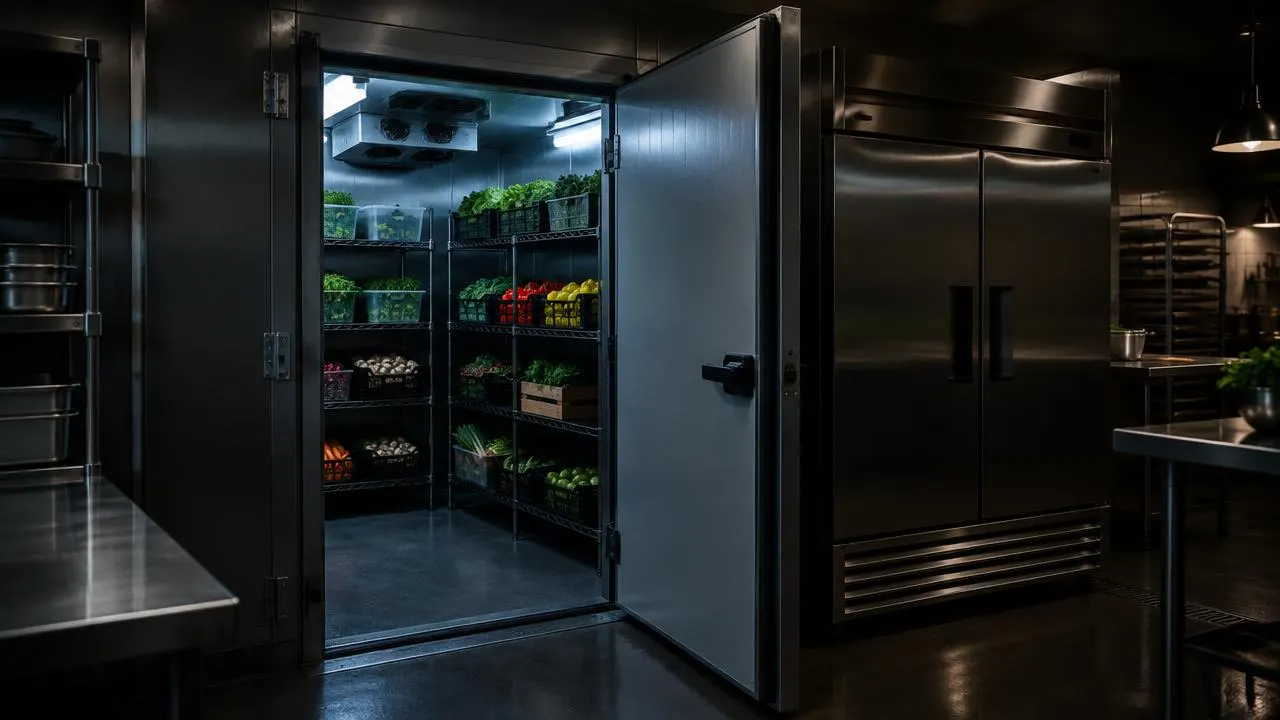
An insulated room with a refrigeration unit, large enough for staff to walk inside. It stores crates, sacks and bulk produce on shelving. It can be set as a chiller or a freezer, or split into both.
Reach-in refrigeration
Upright cabinet refrigerators and freezers, plus undercounter units with a work top above. Staff reach in from outside. They are placed in or near the stations that use them.
Our existing refrigeration equipment guide covers the wider range of commercial refrigeration.
When a walk-in makes sense
- Large stock volumes, such as hotel, canteen and banquet kitchens.
- Bulk deliveries of vegetables, dairy or meat a few times a week.
- Large prepared batches that need cooling and storage.
- Central kitchens supplying several outlets.
- Enough floor area and height for the room and its refrigeration unit.
When reach-ins make more sense
- Small and medium restaurants and cloud kitchens with daily deliveries.
- Limited floor space, where a cold room would take too much area.
- Menus where each station needs its own ingredients close at hand.
- Kitchens that want flexibility to move or add units later.
Using both together
The most common setup in larger kitchens combines both. The walk-in holds bulk stock and prepared items. Each station has reach-in or undercounter refrigeration holding what it needs for the shift, restocked from the walk-in. This reduces the number of times the walk-in door opens during service and keeps cooks at their stations.
Factors to compare
Space
A walk-in needs a dedicated area, door clearance and space for the condensing unit, often outside or on a roof. Reach-ins need floor or under counter space within the kitchen.
Workflow
A walk-in should be near receiving and preparation. Reach-ins should be at the point of use.
Power and heat
Refrigeration runs all day. Condensers release heat, so place them where that heat can escape, not beside cooking equipment. Check the electrical supply for the total refrigeration load.
Hygiene and organisation
Both need separation of raw and cooked food, covered containers and regular cleaning. Walk-ins need good shelving that allows cleaning underneath. Grade 304 stainless steel shelving resists corrosion in cold, damp conditions.
Growth
A walk-in sized with some spare capacity handles growth well. Reach-ins can be added one at a time.
Common mistakes
- Placing reach-ins next to ranges and fryers, which makes them work harder.
- Oversizing a walk-in that sits half empty.
- Forgetting the condensing unit location and ventilation.
- Poor shelving that blocks airflow inside the cabinet or room.
Steelkraft manufactures kitchen refrigeration units and stainless steel shelving and storage in grade 304 stainless steel. For local projects, see our pages on commercial refrigeration equipment in Bangalore and commercial refrigeration equipment in Hyderabad.
Questions to help you decide
- How many deliveries do you receive each week, and how large are they?
- How much stock do you hold on your busiest day?
- Do you prepare large batches that need cooling and storage?
- How much floor area can you give to cold storage?
- Where could a condensing unit be placed with good ventilation?
If deliveries are large and infrequent, and stock is high, a walk-in usually makes sense. If deliveries are daily and stock is modest, reach-ins are often enough.
Maintenance differences
Both need clean condensers, intact door seals and regular temperature checks. Walk-ins also need checks on door closers, floor condition and the insulated panels. Reach-ins are simpler to maintain individually, but a kitchen with many units has more compressors to look after. Factor maintenance into the decision, not only purchase and space.
Organising cold storage
Whichever option you choose, organisation matters. Store raw meat and seafood on the lowest shelves, below ready to eat food, so drips cannot contaminate it. Label containers with contents and dates and use older stock first. Leave gaps between items so cold air can circulate. In walk-ins, keep a clear walkway and do not stack crates against the evaporator. In reach-ins, avoid overloading shelves, which blocks airflow and causes uneven temperatures. Good organisation helps food safety, reduces waste and makes refrigeration run more efficiently, whatever the size of the unit.
Whichever you choose, ask for the cabinet or room interior, shelving and door frames in grade 304 stainless steel, since cold, damp conditions quickly expose weaker materials. Check that shelving can be removed or cleaned underneath, and that door seals can be replaced easily when they wear.
To plan cold storage for your kitchen, write to Steelkraft.
See our refrigeration and display equipment and how cold storage fits a restaurant fit-out. Our refrigeration equipment guide covers the other types.