Commercial dishwasher buying guide: 3 types compared
By Vishwa MenonPublished Updated
Who this is forThis guide is for restaurant, hotel, canteen and cafe owners choosing a commercial dishwasher.
Choose an under-counter dishwasher for small cafes and bars, a hood-type machine for most busy restaurants, and a conveyor dishwasher for hotels, canteens and banquet kitchens washing very large volumes. Base the choice on racks per hour at your busiest time, then check water quality, power, drainage and the layout of the wash area.
Key facts
- Under-counter dishwashers suit small cafes and bars with modest volumes.
- Hood-type, or pass-through, dishwashers suit most busy restaurants.
- Conveyor dishwashers suit hotels, canteens and banquet kitchens with very high volumes.
- Water quality, power, drainage and the layout of the wash area matter as much as the machine.
Work out your volume first
Count the plates, glasses, cutlery and utensils used at your busiest hour, then convert that into racks. Allow for crockery being reused during service, which means it has to be washed quickly. Choosing a machine on average volume leads to a pile up of dirty dishes at peak.
Under-counter dishwashers
These sit under a counter like a domestic machine, but run faster and hotter. Staff load one rack at a time from the front.
- Suit cafes, bars, small restaurants and pantries.
- Need little space and fit into existing counters.
- Good for glasses and small volumes of crockery.
- Limited for large pots and high volume service.
Hood-type dishwashers
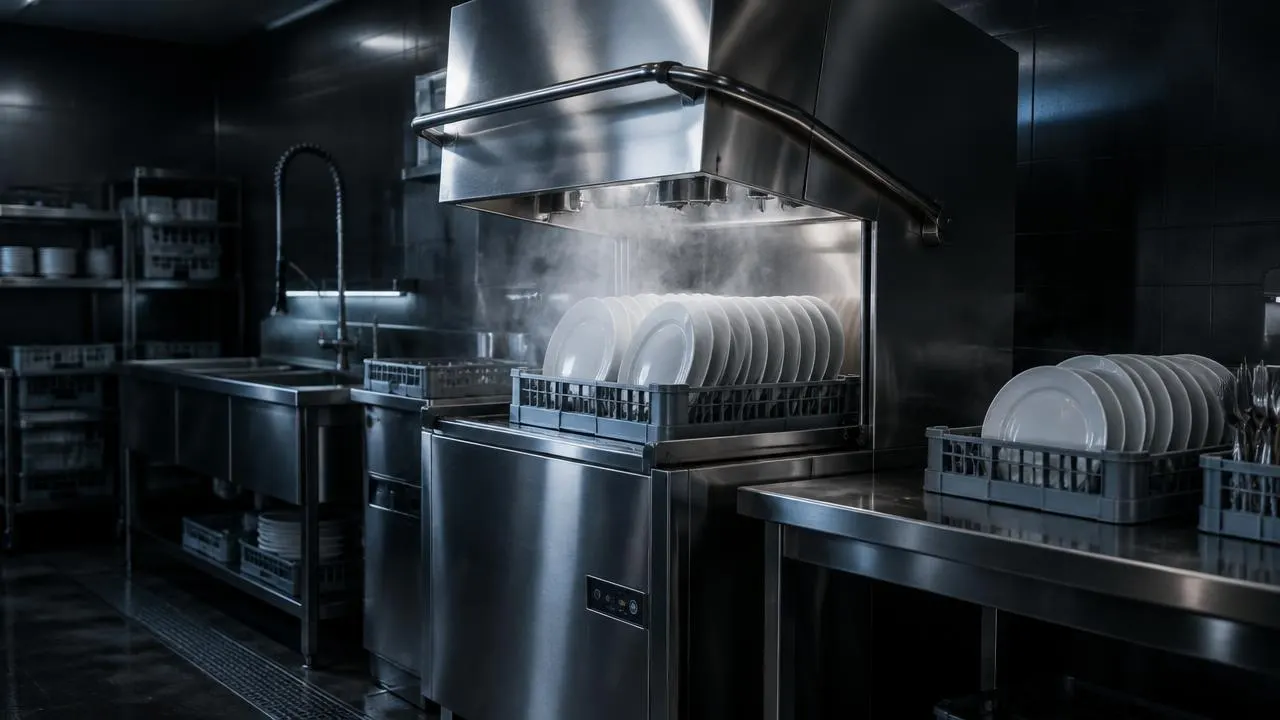
Also called pass-through machines. Racks slide in from one side, the hood is lowered, the cycle runs and racks slide out the other side. They work with a dirty dish table on one side and a clean table on the other.
- Suit busy restaurants and medium sized hotel outlets.
- Much higher capacity than under-counter machines.
- Fit into a straight line or corner wash area.
- Staff work standing up, which is easier during long shifts.
Conveyor dishwashers
Racks move continuously through wash and rinse zones on a conveyor. Staff load at one end and unload at the other.
- Suit hotels, institutional canteens, hospitals and banquet kitchens.
- Highest capacity of the three types.
- Need a long wash area and more water, power and drainage.
- Usually need more than one person at peak.
Factors beyond capacity
Water quality
Hard water leaves scale on heating elements and spots on glasses. Many sites need a water softener. Check water hardness before installation.
Power and hot water
Commercial dishwashers heat water to high temperatures for washing and sanitising. Check the electrical supply, and whether the machine has its own booster heater or needs a hot water feed.
Drainage
Plan a floor drain near the machine and make sure the drainage can handle the discharge.
Ventilation
Dishwashers release steam, especially when the hood or door opens. Plan extraction over larger machines.
Wash area layout
The machine is only one part of the wash area. Plan a dirty dish table with a pre rinse sink, the machine, a clean table and storage for clean racks. The flow should keep dirty and clean items apart. Our dish tables and pot wash sinks includes dish tables, pre rinse sinks and pot wash units built for this layout.
Do not forget pot washing
Large pots, pans and trays often do not fit standard dishwasher racks. Most kitchens still need a deep pot wash sink or a dedicated utensil washer alongside the dishwasher.
Maintenance
Clean filters and wash arms daily, descale regularly where water is hard and check rinse temperatures. A neglected machine washes poorly and uses more water and power. Our article on commercial kitchen AMC planning covers servicing arrangements.
Steelkraft supplies commercial dishwashers and manufactures the stainless steel wash area equipment around them, along with imported equipment where a project needs it. For local projects, see our pages on hotel kitchens in Bangalore and canteen kitchen equipment in Mumbai.
Chemicals and dosing
Commercial dishwashers rely on the right detergent and rinse aid at the right dose. Too little leaves dirty or spotted dishes. Too much wastes chemicals and can leave residue. Most machines use automatic dosing pumps that should be set up during installation and checked regularly. Store chemicals safely away from food.
Common mistakes
One mistake is choosing a machine on average volume and then struggling at peak. Another is ignoring water hardness, which leads to scale, poor results and early repairs. A third is installing the machine without a proper dirty and clean table layout, so staff stack dishes on any available surface and clean items get contaminated.
Some kitchens also forget about steam. Opening a hot dishwasher releases a cloud of steam that settles on walls and ceilings without extraction.
Planning the space
Measure the wash area, door widths and access routes before choosing a machine. Allow space for staff to load, unload and stack racks safely.
Glasswashers and specialist machines
Bars and cafes that wash mainly glasses may benefit from a dedicated glasswasher, which uses gentler cycles and suits glass racks. Hotels and canteens with many large pots and trays may add a utensil washer designed for bulky items. These specialist machines sit alongside a main dishwasher rather than replacing it. Think about the mix of items you wash, not only the total number, before deciding which machines the wash area needs. A well matched set of machines keeps every type of item moving quickly during service.
To plan a wash area around the right dishwasher, ask our planning team.
We supply commercial dishwashers and glasswashers as brand partners and fit them into restaurant kitchens. The wash area also comes up in our FSSAI inspection equipment audit.