
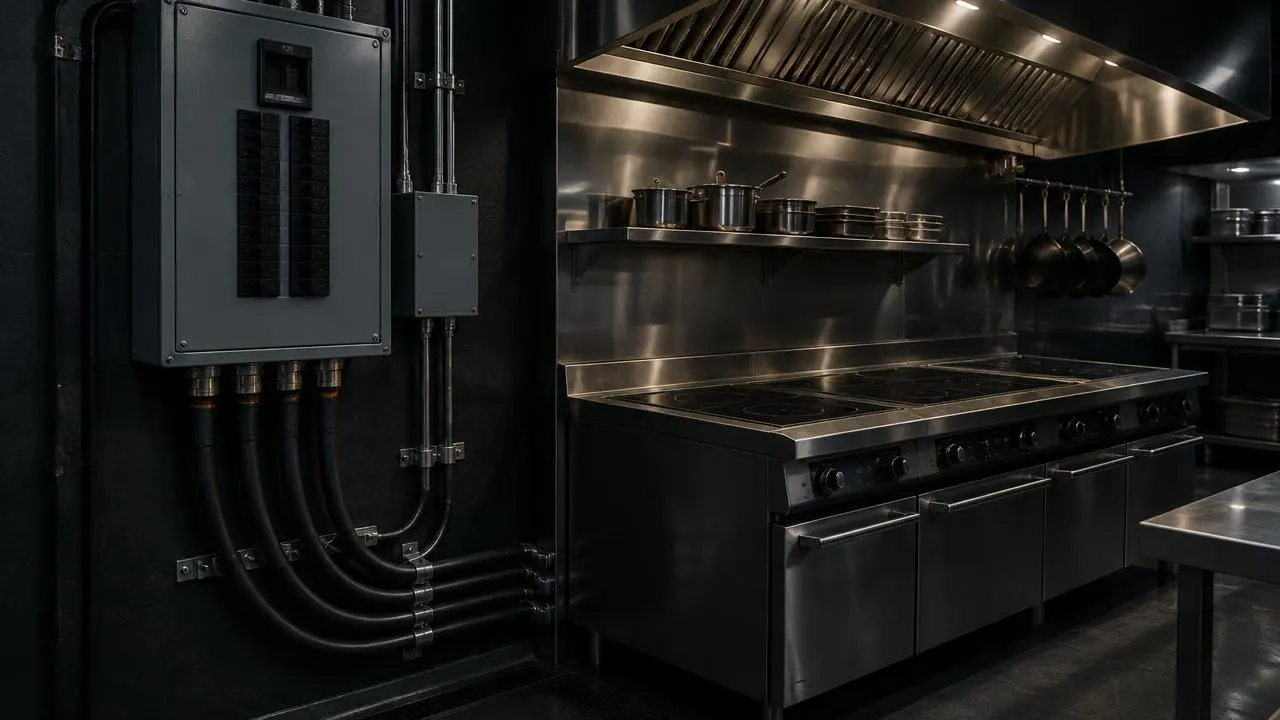
Commercial induction range power load and wiring
Who this is forThis guide is for kitchen owners, project managers and electrical contractors planning a commercial induction range in India.
To plan power for a commercial induction range, add up the rated kilowatts of every induction unit, allow for other electrical equipment running at the same time, and compare the total with the premises' sanctioned load. Then have a licensed electrician design dedicated three phase circuits, protection and earthing before the equipment is installed.
Key facts
- The rated power of every induction unit should be added up before any wiring is designed.
- Most commercial induction equipment runs on three phase supply with dedicated circuits.
- The sanctioned load of the premises often needs to be increased for a full induction line.
- Good earthing and correct protective devices are essential for induction electronics.
Why power planning comes first
Induction equipment is only as reliable as the supply behind it. An undersized cable, a crowded distribution board or poor earthing leads to tripping in the middle of service, overheated connections and failed electronics. Fixing this after installation is slower and more disruptive than planning it at the start.
Step 1: list every electrical load
Start with the rated power printed on each induction unit's specification. Then add the rest of the kitchen's electrical equipment that may run at the same time.
- Induction tops, wok units, stock pot units and griddles.
- Electric fryers, combi ovens and salamanders.
- Refrigeration, including cold rooms and reach-in units.
- Dishwashers, especially models with built-in water heating.
- Exhaust fans, fresh air fans and lighting.
Not everything runs at full power at the same moment, so electricians apply a diversity factor. That calculation should be done by the electrical designer, not guessed, because it depends on how the kitchen actually works.
Step 2: check the sanctioned load
Every commercial electricity connection has a sanctioned load agreed with the distribution company. If the total demand of the kitchen goes beyond it, you will need to apply for an increase. This can take time and may involve a new meter or transformer work, so start the application as soon as the equipment list is fixed.
In shared buildings such as malls and food courts, also check the building's own limits. The landlord may cap the load each unit can draw.
Step 3: design the circuits
Dedicated circuits
Each major induction unit should have its own circuit from the distribution board. Sharing circuits between high power units is a common cause of nuisance tripping.
Phase balancing
On three phase supply, the electrician should spread the load evenly across the phases. An unbalanced kitchen can trip or overheat one phase while others sit underused.
Protection
Circuit breakers and earth leakage protection must suit the equipment. Induction electronics can behave differently from simple heating elements, so follow the equipment manufacturer's recommendations on the type of protection.
Cable routing
Cables to a cooking line run in a hot, wet, greasy area. They should be correctly rated, protected and kept away from drains and direct heat. Isolation switches near each unit make cleaning and servicing safer.
Step 4: earthing
Poor earthing is a frequent cause of induction faults. Have the earth resistance tested and improved if needed before installation. This protects both staff and equipment.
Step 5: think about power quality and backup
Voltage fluctuations and frequent outages can affect induction equipment. Ask the electrician whether stabilisation or surge protection is needed. If the premises relies on a generator, check its capacity, because a full induction line may need a much larger set than a gas kitchen did. Some kitchens keep a small gas section partly for this reason, and our guide to planning dual fuel kitchens explains how to combine the two.
How equipment design helps
The way the cooking line is built affects electrical work too. Stands and counters should leave room for cable entry, ventilation for the electronics and access for service. Steelkraft manufactures commercial cooking equipment and stainless steel kitchen equipment fabricated in-house, so these details can be designed into the line rather than added on site.
For local projects, see our pages on cloud kitchen equipment in Bangalore and industrial kitchen equipment in Karnataka. If you are moving an existing kitchen across, our guide to switching a restaurant from LPG to induction covers the phases in order.
Common mistakes to avoid
The most frequent mistake is planning electrical work after the equipment has been chosen and delivered. Another is copying the wiring of a gas kitchen and simply adding sockets. Induction units need dedicated, correctly protected circuits, not shared outlets. A third is ignoring the rest of the kitchen. Refrigeration, dishwashers and exhaust fans all add to the load, and they run at the same time as the cooking line during service.
Kitchens in older buildings face extra risk. Old cables, overloaded distribution boards and weak earthing are common. A proper survey before work begins avoids surprises halfway through installation.
Documents to collect
Before the electrician starts, gather the equipment specification sheets with rated power and connection type, the current electricity bill showing the sanctioned load, the building's electrical drawings if available and the landlord's limits for the unit. Having these in one place speeds up design and approval and gives the electrician what they need to size the system correctly.
Frequently asked questions
Does a commercial induction range need three phase supply?
Most commercial induction units of useful size are designed for three phase supply. Smaller countertop units may run on single phase, but a full cooking line almost always needs three phase.
Why does induction equipment trip the breaker?
Common causes are shared circuits, unbalanced phases, protection devices that do not suit the equipment and poor earthing. A proper load study and circuit design prevent most of these problems.
Who should design the wiring for an induction kitchen?
A licensed electrical contractor should design and install it, working from the equipment specifications. The kitchen equipment manufacturer should share the rated loads and connection details early.
If you are planning an induction line and need equipment specifications for your electrician, contact Steelkraft.